BRICS Backs Expert Group on Traditional Medicine, Calls for Evidence-Based Global Cooperation
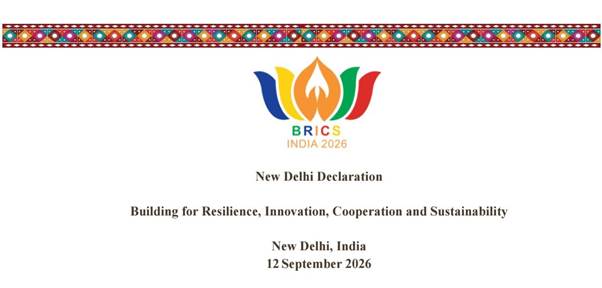
The New Delhi Declaration adopted at the 18th BRICS Summit has endorsed international cooperation in Traditional, Complementary and Integrative Medicine (TCIM) by welcoming a proposed BRICS Expert Working Group on TCIM. The initiative aims to strengthen health systems, advance evidence-based research on medicinal plants, and promote safe and affordable healthcare.
Why It Matters
This is relevant for competitive exams covering international summits, government ministries like AYUSH, and global public health policies.
In Simple Words
The 18th BRICS Summit adopted the New Delhi Declaration, which supports international cooperation in Traditional, Complementary and Integrative Medicine (TCIM). It welcomes a proposed BRICS Expert Working Group to encourage dialogue, share knowledge, and advance research.
Union Minister Shri Prataprao Jadhav and Ayush Secretary Vaidya Rajesh Kotecha noted that this cooperation supports safe, effective, and affordable healthcare through scientific research and regulatory frameworks. The WHO has described this initiative as a significant development.
Key Points
- The New Delhi Declaration was adopted at the 18th BRICS Summit.
- It welcomed the proposed establishment of a BRICS Expert Working Group on TCIM under the BRICS Health Track.
- Union Minister of State for Ayush is Shri Prataprao Jadhav.
- Vaidya Rajesh Kotecha serves as the Secretary of the Ministry of Ayush.
- The BRICS Meeting on TCIM was held in Chandigarh on July 21, 2026, under India's BRICS Chairship.
- The WHO Global Traditional Medicine Strategy spans 2025–2034.
- The Declaration emphasizes cooperation in research on medicinal plants and herbal preparations.
- It reaffirms ensuring the quality, safety, and efficacy of TCIM practices and products.
Exam Angle
A. Chandigarh
Source: Press Information Bureau