
Data Centres in India Infrastructure for the Digital Age
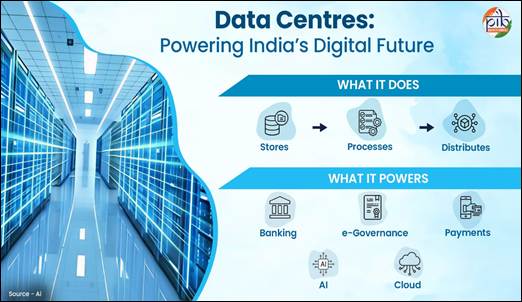
Data centres form the critical digital infrastructure powering India's economy, e-governance, and online services by storing, processing, and distributing large volumes of information. Driven by rapid technological advancements and a supportive policy ecosystem including infrastructure status and tax incentives, India's data centre capacity has expanded significantly. The sector's continuous growth is supported by clean energy initiatives, advanced cooling technologies, and standardisations for energy and water efficiency.
Why It Matters
This topic is relevant for competitive exams under economics, governance, science and technology, and current affairs, particularly regarding India's digital infrastructure growth, budgetary policy measures, and clean energy integration.
In Simple Words
Data centres are secure facilities housing computing, storage, and networking equipment that process and distribute digital information for banking, cloud computing, and e-governance. They rely on continuous power backups, HVAC cooling systems, and IT hardware like servers and databases to handle user requests within seconds.
To support this growth, the Indian government has granted data centres infrastructure status, introduced tax holidays for foreign cloud providers, and launched linked ecosystem schemes like Semicon India and the IndiaAI Mission. Energy and resource efficiency are maintained through Bureau of Indian Standards (BIS) metrics, BEE building codes, and renewable energy adoption.
Key Points
- Installed data-centre power capacity stood at around 375 MW in 2020 and reached 1.57 GW as of August 2026.
- Data centre power capacity is projected to expand to nearly 8 GW by 2030.
- Investments of nearly USD 70 billion are underway with an additional USD 90 billion in announced projects.
- Data centres were included in the Harmonized List of Infrastructure in the Union Budget 2022-23.
- The Union Budget 2026-27 introduced a tax holiday for eligible foreign cloud service providers until 2047.
- The second phase of the Semicon India Programme (Semicon 2.0) was approved on 15.07.2026 with an outlay of ₹1,27,500 crore.
- The IndiaAI Mission was approved with a total budget outlay of ₹10,371.92 crore.
- The Central Electricity Authority (CEA) projects data centre power demand could reach 17 GW by 2031-32.
Exam Angle
A. 1.57 GW
Source: Press Information Bureau