
India reaffirms Commitment to Ozone Layer Protection and Climate Action at 32nd World Ozone Day Celebration in Mumbai
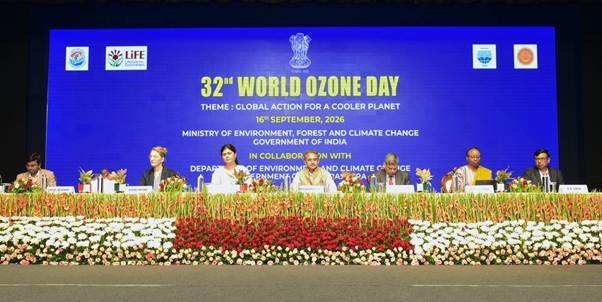
The Union Ministry of Environment, Forest and Climate Change organized the 32nd World Ozone Day celebration in Mumbai with the theme 'Global Action for a Cooler Planet.' During the event, dignitaries launched India's Net Zero Portal and the National Action Plan on Climate Change (NAPCC) Dashboard to track climate commitments and missions. Officials highlighted India's successful fulfillment of Montreal Protocol commitments and discussed ongoing collaborations in climate-friendly cooling and technician training.
Why It Matters
This press release contains factual data regarding India's implementation of the Montreal Protocol, ozone-depleting substances, and the Kigali Amendment, which are relevant for environment and current affairs sections in competitive exams.
In Simple Words
The Ministry of Environment, Forest and Climate Change celebrated the 32nd World Ozone Day in Mumbai under the theme 'Global Action for a Cooler Planet.' Dignitaries launched the Net Zero Portal and the NAPCC Dashboard to track climate commitments and national missions.
India highlighted its success in meeting Montreal Protocol targets ahead of schedule, phasing out substances like CFCs and HCFCs. New skill-development initiatives were announced, including training 25,000 technicians and adopting 248 Industrial Training Institutions by manufacturers for eco-friendly cooling technologies.
Key Points
- The 32nd World Ozone Day national celebration was held in Mumbai with the theme 'Global Action for a Cooler Planet.'
- India's Net Zero Portal and the National Action Plan on Climate Change (NAPCC) Dashboard were launched at the event.
- India has been a Party to the Vienna Convention and the Montreal Protocol since 1992.
- India has met all phase-out targets for HCFCs for 2015, 2020, and 2025.
- India ratified the Kigali Amendment to the Montreal Protocol in September 2021, which came into force on 26 December 2021.
- GIZ and India are working together on the HCFC Phase-out Management Plan Stage III (2025–2030) to train 25,000 technicians by 2030.
- 248 Industrial Training Institutions were adopted by 12 Refrigeration and Airconditioning (RAC) manufacturers through a 4-Party Memorandum of Agreement.
- CFCs, Carbon tetrachloride (CTC), and Halons have already been phased out in India for controlled applications.
Exam Angle
A. Global Action for a Cooler Planet
Source: Press Information Bureau