
International Deep-sea Macrofauna Taxonomy School Commences at CMLRE, Kochi under ISA and MoES Collaboration
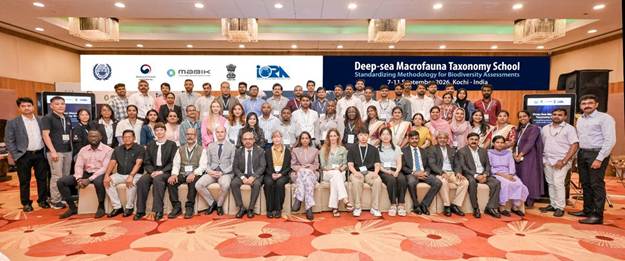
The Centre for Marine Living Resources and Ecology in Kochi has started a five-day Deep-sea Macrofauna Taxonomy School under a collaboration between the International Seabed Authority and the Ministry of Earth Sciences. The program brings together about 30 early-career researchers from Indian Ocean Region countries to receive training in marine biodiversity assessment. The initiative aims to standardize methodologies and strengthen scientific cooperation for deep seabed environmental management.
Why It Matters
This is relevant for competitive exam candidates tracking India's international scientific collaborations, environmental initiatives, and programs under the Ministry of Earth Sciences or Deep Ocean Mission.
In Simple Words
The Centre for Marine Living Resources and Ecology (CMLRE) in Kochi has launched a five-day training school on deep-sea macrofauna taxonomy. Operating under the Ministry of Earth Sciences, the program runs from September 7 to 11, 2026, as part of the International Seabed Authority's Sustainable Seabed Knowledge Initiative.
Around 30 early-career researchers from Indian Ocean Region nations are participating in hands-on laboratory training, lectures, and workshops focused on marine biodiversity, DNA barcoding, and standardized benthic assessments.
Key Points
- The Deep-sea Macrofauna Taxonomy School commenced in Kochi on September 7, 2026.
- The program is organized by CMLRE under the Ministry of Earth Sciences and the International Seabed Authority.
- It runs from September 07–11, 2026 under the Sustainable Seabed Knowledge Initiative platform.
- Collaborating bodies include CMLRE, ISA, IORA, and MABIK.
- About 30 early-career researchers from ISA Member States in the Indian Ocean Region are participating.
- Participating nations include South Africa, Kenya, Bangladesh, Mauritius, Malaysia, Indonesia, Singapore, Sri Lanka, Mozambique, Tanzania, Thailand, Oman, and India.
- The curriculum covers traditional taxonomy, DNA barcoding, Scanning Electron Microscopy, and biodiversity data analysis.
- Ms. Leticia Carvalho, Secretary-General of the ISA, attended as the Chief Guest.
Exam Angle
A. International Seabed Authority (ISA)
Source: Press Information Bureau