
NAMASTE Strengthens Safety Dignity and Livelihood Support for Sanitation Workers
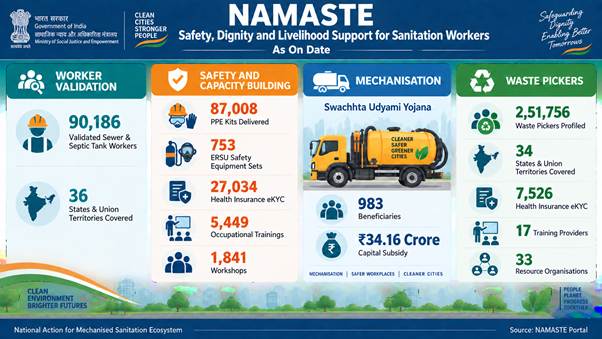
The NAMASTE scheme is working across Indian states and union territories to improve safety, dignity, and livelihoods for sanitation workers and waste pickers. It provides safety equipment, health insurance, training, and capital subsidies for mechanization through the Ministry of Social Justice and Empowerment.
Why It Matters
This scheme update provides factual data on social welfare interventions relevant for government exam questions covering central government schemes and social sector policies.
In Simple Words
The National Action for Mechanized Sanitation Ecosystem (NAMASTE) Scheme aims to protect sanitation workers and waste pickers by recognizing their work and providing safety gear, health insurance, training, and financial support for mechanization.
As shared by the Ministry of Social Justice and Empowerment, the scheme has validated thousands of sewer and septic tank workers, distributed Personal Protective Equipment kits, completed health-insurance eKYCs, and provided capital subsidies through the Swachhta Udyami Yojana.
Key Points
- NAMASTE scheme stands for National Action for Mechanized Sanitation Ecosystem.
- Sewer and septic tank workers component covers 36 States and Union Territories with 90,186 validated workers.
- Validated workforce includes 86,468 men, 3,713 women, and five transgender persons.
- Over 87,008 Personal Protective Equipment (PPE) kits and 753 Emergency Response Sanitation Unit safety equipment sets distributed.
- Swachhta Udyami Yojana supported 983 beneficiaries with Rs 34.16 crore under capital-subsidy intervention.
- Waste-picker component profiled 2,51,756 waste pickers across 34 States and Union Territories.
- Interventions are implemented by the National Safai Karamcharis Finance and Development Corporation (NSKFDC).
- Ministry has undertaken 27,034 health-insurance eKYC completions for sewer and septic tank workers.
Exam Angle
A. 2,51,756 waste pickers
Source: Press Information Bureau