
Sediments from Bakhira Lake can help water resource management in the Central Ganga Plain
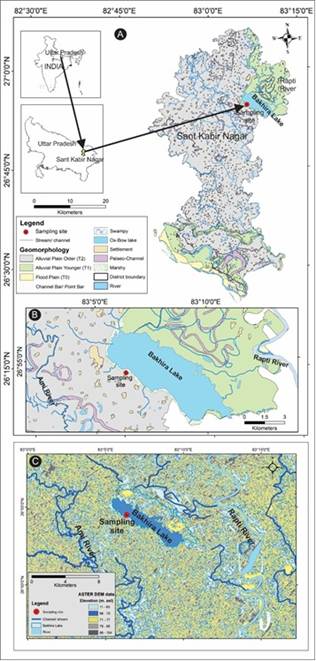
A new study analyzing magnetic minerals in Bakhira Lake sediments over 25,000 years has tracked past climate and monsoon changes in northern India. Researchers from the Birbal Sahni Institute of Palaeosciences investigated these sediments to improve climate models, predict future monsoon behaviour, and aid water resource management in the Central Ganga Plain.
Why It Matters
This study is relevant for competitive exam aspirants focusing on geography, environment, and science & technology, specifically regarding Indian monsoon history, paleoclimate studies, and regional water resource management in the Central Ganga Plain.
In Simple Words
A recent study examined magnetic minerals found in the sediments of Bakhira Lake in Sant Kabir Nagar over a 25,000-year timeline. Conducted by researchers at the Birbal Sahni Institute of Palaeosciences, the research helped track past climate changes, rainfall, weathering, and lake processes in northern India.
The findings provide a continuous terrestrial archive of monsoon variability dating back to the Last Glacial Maximum. This data helps improve climate models to predict future monsoon patterns and supports better water resource management, agricultural planning, and drought mitigation in the Central Ganga Plain.
Key Points
- Study focused on magnetic minerals accumulated in sediments below Bakhira Lake over 25,000 years.
- Conducted by researchers of Birbal Sahni Institute of Palaeosciences (BSIP), an autonomous institute of DST.
- Bakhira Lake is located in the Ghaghara–Rapti alluvial system in Sant Kabir Nagar and was designated as a Ramsar Site in 2022.
- The sediment sequence extends back to approximately 25 ka and is constrained by seven AMS radiocarbon dates.
- Identified major climatic events including Last Glacial Maximum, Heinrich Stadial 1, Bølling–Allerød, Younger Dryas, Holocene Climatic Optimum, and late Holocene droughts.
- Published in the journal Palaeogeography, Palaeoclimatology, Palaeoecology.
- Helps pave the way for improved climate models to predict future monsoon behaviour.
- Aids better water resource management, agriculture, and flood and drought mitigation in the Central Ganga Plain.
Exam Angle
A. Birbal Sahni Institute of Palaeosciences (BSIP)
Source: Press Information Bureau