
Self-assembly of organic molecules opens a new path to green hydrogen production
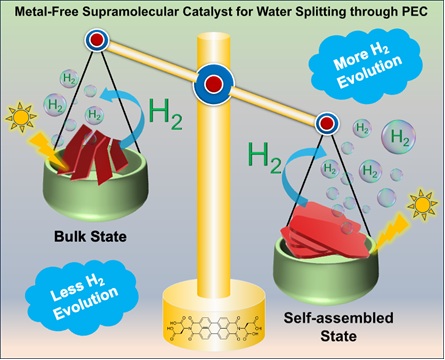
Researchers at the Centre for Nano and Soft Matter Sciences (CeNS) in Bengaluru have developed a new metal-free organic material for green hydrogen production by integrating aspartic acid with perylene diimide (PDI). This self-assembled 2D nanosheet material enhances solar-driven water splitting, generating nearly 18% higher photocurrent than its bulk counterpart. The study offers a sustainable, cost-effective route for solar energy conversion.
Why It Matters
This press release covers a scientific innovation involving clean energy and nanotechnology by an autonomous institute under the Department of Science and Technology, making it relevant for competitive exam questions related to science, technology, and environment.
In Simple Words
Researchers integrated a natural amino acid (aspartic acid) with a light-absorbing organic molecule (perylene diimide) to improve solar-driven hydrogen production using metal-free materials. This self-assembled into ordered two-dimensional nanosheets in water.
The molecular design broadened light absorption, enhanced charge separation, and generated nearly 18% higher photocurrent during solar-driven water splitting compared to bulk counterparts. This sustainable approach reduces reliance on costly precious metals.
Key Points
- Researchers are from the Centre for Nano and Soft Matter Sciences (CeNS), Bengaluru, an autonomous institute under the DST.
- The strategy integrates naturally occurring amino acid (aspartic acid) with a light-absorbing organic molecule (perylene diimide or PDI).
- Molecules spontaneously organize themselves through supramolecular self-assembly into two-dimensional nanosheets in water.
- The self-assembled material generated nearly 18% higher photocurrent than its bulk counterpart during solar-driven water splitting.
- The amino acid moiety promotes hydrogen bonding, while the PDI chromophore drives pi-pi stacking and light absorption.
- The study was published in the Journal of Materials Chemistry A by the Royal Society of Chemistry.
- The work was led by Dr. Goutam Ghosh and Dr. Ashutosh K. Singh, along with Mr. Sourav Moyra, Mr. Kumar Shubham, and Ms. Athira Chandran M.
- The method provides a sustainable route for metal-free photocatalysts in green hydrogen production.
Exam Angle
A. Aspartic acid
Source: Press Information Bureau