
Academia Industry collaboration traced the mechanism of how preservatives take down bacteria enabling smarter preservation
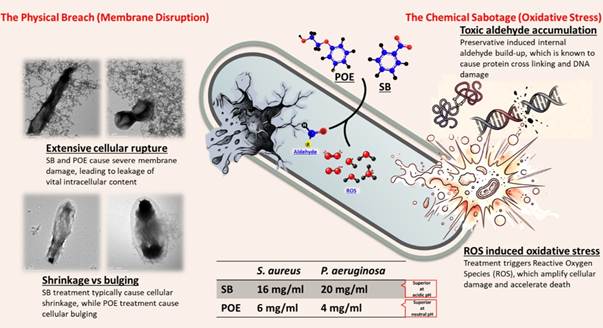
Scientists have captured how preservatives like sodium benzoate and phenoxyethanol attack bacteria, revealing a dual mode of action involving cell envelope disruption and internal biochemical damage. The research, conducted by INST Mohali in collaboration with Unilever R&D Bangalore, used advanced imaging and biochemical analyses on Staphylococcus aureus and Pseudomonas aeruginosa. The findings help in designing smarter preservation technologies and optimizing preservative performance for different formulations.
Why It Matters
The source text is relevant for competitive exam candidates studying developments in science and technology, specifically nanotechnology, microbiology, and institutional research collaborations involving Indian scientific bodies like INST Mohali.
In Simple Words
Scientists have observed for the first time how common preservatives destroy bacteria using advanced imaging and chemical analysis. Researchers from INST Mohali and Unilever R&D studied sodium benzoate and phenoxyethanol against bacterial pathogens to understand their mechanisms.
They found that preservatives compromise the cell envelope and cause internal biochemical damage. Sodium benzoate causes cellular shrinkage in acidic environments, while phenoxyethanol causes membrane expansion and rupture, helping industries design smarter and safer preservation technologies.
Key Points
- Scientists captured the moment bacteria succumb to preservative attack using advanced imaging and chemical analysis.
- Both Sodium benzoate (SB) and Phenoxyethanol (POE) are effective preservatives studied in the research.
- Sodium benzoate was approved by the US FDA as a food preservative in 1908, used in pickles, ketchup, and fizzy drinks.
- Phenoxyethanol has been used in shampoo, moisturiser, sunscreen, and vaccines for decades.
- The research was conducted by Institute of Nano Science Technology (INST) Mohali in collaboration with Unilever R&D Bangalore.
- The study investigated Staphylococcus aureus (Gram-positive) and Pseudomonas aeruginosa (Gram-negative).
- Sodium benzoate induced cellular shrinkage and collapse and is about sixteen times more potent in acidic environments.
- Phenoxyethanol caused membrane expansion and eventual rupture, displaying consistent efficacy across a wide pH range.
Exam Angle
A. Institute of Nano Science Technology (INST) Mohali
Source: Press Information Bureau