
Conference on “Financing India’s Journey towards Viksit Bharat” concludes in New Delhi today
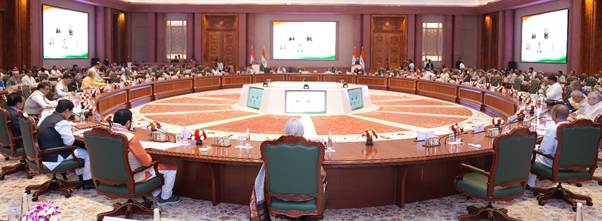
A two-day conference titled “Financing India’s Journey towards Viksit Bharat’ concluded in New Delhi, bringing together Union and State finance ministers, secretaries, and experts to deliberate on growth pathways. Discussions focused on boosting savings, agricultural transformation, energy transition, and leveraging private capital alongside public finances. The conference concluded with a proposal to hold such collaborative meetings annually.
Why It Matters
Important for competitive exams covering Indian economy, fiscal federalism, government policies, and national development frameworks like Viksit Bharat.
In Simple Words
The two-day conference in New Delhi brought together central and state leaders, banking experts, and policymakers to discuss how to finance India's growth toward becoming a developed nation. Key topics included increasing domestic savings, leveraging private sector investments, and improving resource mobilization across states.
Eminent speakers emphasized enhancing agricultural financing and renewable energy transitions while maintaining fiscal discipline. Officials agreed that achieving Viksit Bharat requires strong cooperation between the Union and the States, along with sound project planning and private capital participation.
Key Points
- The conference was titled “Financing India’s Journey towards Viksit Bharat” and concluded in New Delhi.
- It was attended by the Union Minister for Finance and Corporate Affairs, along with various Chief Ministers, Deputy Chief Ministers, and State Finance Ministers.
- Smt. Anuradha Thakur, Secretary, Department of Economic Affairs, noted four sovereign rating upgrades for India over the past 16-17 months, including a JCR upgrade from BBB+ to A-.
- Shri N.K. Singh highlighted that India's gross domestic savings rate needs to rise from about 34 percent to 38-40 percent of GDP.
- Thematic sessions covered Macroeconomic Overview, Financing Agriculture Sector Transformation, and Financing the Energy Transition.
- Dr. V. Anantha Nageswaran, Chief Economic Adviser, suggested raising state capital outlay from approximately 2.4 percent to 3 percent of GSDP by 2031-32.
- Working groups with state participation will take forward thematic deliberations and sectoral recommendations.
- The conference featured special presentations on measuring GSDP and the role of new-age technology.
Exam Angle
𝕏 Official Update
A. Around 34 per cent of GDP
Source: Press Information Bureau