
Beyond one: Indian researchers’ experiment could lead to a new tool for quantum measurement
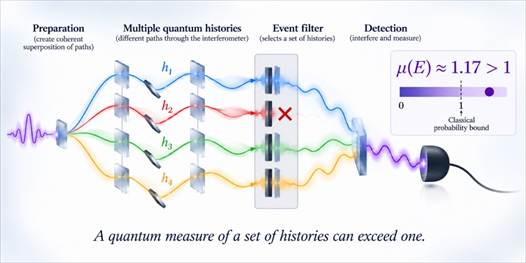
Indian researchers have made the first experimental measurement of a quantum measure exceeding one, bringing Quantum Measure Theory (QMT) into the laboratory. Conducted by physicists at the Raman Research Institute (RRI), the experiment used an "event-filter" based on photon routes and polarisation to measure a quantum measure of about 1.17, which surpasses ordinary classical probability.
Why It Matters
It is unclear how this specific research announcement is directly relevant to competitive exams beyond basic scientific awareness of the institution involved.
In Simple Words
Researchers successfully measured a quantum measure exceeding one for the first time, bringing Quantum Measure Theory out of pure theory and into a physical laboratory experiment. Unlike ordinary classical probability, which cannot exceed one, quantum measures can surpass this limit due to the interference between different possible routes a photon can take.
Physicists at the Raman Research Institute built an "event-filter" using laser routes and polarisation to select specific photon paths and erase distinguishing information so they could interfere. They measured a quantum measure of about 1.17, matching theoretical predictions and demonstrating that this abstract concept can actually be measured experimentally.
Key Points
- Researchers made the first experimental measurement of a quantum measure exceeding one.
- The work brings Quantum Measure Theory (QMT) from theory into the laboratory.
- The experiment was conducted by the Raman Research Institute (RRI), an autonomous institute of the Department of Science and Technology (DST).
- Sanchari Chakraborti performed the experiment under the supervision of senior professor Urbasi Sinha.
- Researchers built an "event-filter" using photon routes and polarisation to select paths and allow interference.
- The measured quantum measure was about 1.17, aligning with the theoretical prediction of about 1.18.
- Rafael Sorkin developed the quantum measure central to QMT partly in the search for quantum gravity.
- The study was published in the journal Quantum.
Exam Angle
A. About 1.17
Source: Press Information Bureau