
Historical Background: Company Rule (1773–1858)
Evolution of British administrative apparatus from the Regulating Act of 1773 to the Government of India Act 1858. Centralization, Double Government, and legal foundations.
1. Introduction: From Merchants to Rulers
The British arrived in India in 1600 as traders in the form of the East India Company (EIC), which had exclusive trading rights granted under a Royal Charter by Queen Elizabeth I.
After the Battle of Buxar (1764), the Company obtained the Diwani Rights (rights over revenue and civil justice) of Bengal, Bihar, and Odisha in 1765 from Mughal Emperor Shah Alam II. This marked the shift of the Company from a purely commercial entity into a territorial power.
Constitutional history of British India is broadly divided into two major phases:
- The Company Rule (1773–1858)
- The Crown Rule (1858–1947)
Two Eras of British Rule: Company Rule vs. Crown Rule
The Company Rule
1773 – 1858
Regulation of East India Company commercial & administrative powers by British Parliament.
Governor of Bengal became Governor-General (Warren Hastings); Supreme Court at Calcutta (1774).
Court of Directors (Trade) + Board of Control (Political & Military).
Ended commercial monopoly except Tea & China trade; ₹1 Lakh annual education fund.
Governor-General of India (William Bentinck); Law member (Macaulay); EIC became purely administrative.
Separation of Legislative & Executive powers; Open civil services competition.
Revolt of 1857
EIC abolished; direct Crown control triggered
The Crown Rule
1858 – 1947
Direct imperial sovereignty exercised by British Crown via Secretary of State & Viceroy.
EIC dissolved; Governor-General titled Viceroy (Lord Canning); Secretary of State created.
Portfolio system (1861), budget debate right (1892), separate electorates (Morley-Minto 1909).
Transferred and Reserved subjects in provinces; Bicameral legislature at Centre.
All-India Federation proposal; Provincial Autonomy; Federal Court established.
Creation of two independent dominions (India & Pakistan); complete end of British rule.
2. Regulating Act of 1773
This was the first landmark step taken by the British Government to control and regulate the affairs of the East India Company in India.
Key Provisions:
- Designation of Governor-General: The Governor of Bengal was designated as the 'Governor-General of Bengal' and provided with an Executive Council of 4 members to assist him. Lord Warren Hastings became the first Governor-General of Bengal.
- Subordination of Presidencies: The Governors of Bombay and Madras Presidencies were made subordinate to the Governor-General of Bengal (previously independent).
- Establishment of Supreme Court: Provided for the establishment of a Supreme Court at Calcutta (1774) comprising one Chief Justice (Sir Elijah Impey) and three other judges.
- Prohibition of Private Trade: Prohibited the servants of the Company from engaging in any private trade or accepting presents/bribes from native residents.
- Court of Directors: Strengthened control of the British Government by requiring the Court of Directors (governing body of EIC) to report on revenue, civil, and military affairs in India.
Frequent Exam Confusion:
- First Governor-General of Bengal: Lord Warren Hastings (Regulating Act 1773)
- First Governor-General of India: Lord William Bentinck (Charter Act 1833)
- First Viceroy of India: Lord Canning (Government of India Act 1858) Always read the suffix ("of Bengal" vs "of India") carefully in competitive exams!
The Conflict of Jurisdiction: Raja Nand Kumar accused Governor-General Warren Hastings of taking bribes. In response, Hastings and Chief Justice Elijah Impey tried Nand Kumar under English forgery laws and sentenced him to hanging. Constitutional Impact: This blatant abuse of judicial power triggered extreme outrage in Britain and directly led to the Amending Act of 1781 (Act of Settlement), which exempted the Governor-General and his Council from the jurisdiction of the Supreme Court for actions done in their official capacity.
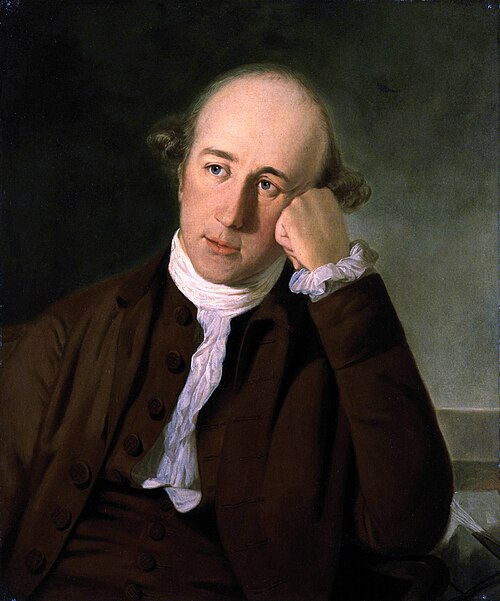
Warren Hastings — First Governor-General of Bengal (1773–1785)
The Regulating Act of 1773 created this office and established the Supreme Court at Calcutta (1774).
3. Pitt's India Act of 1784
Introduced by British Prime Minister William Pitt the Younger to rectify the defects of the 1773 Act.
Key Provisions:
- Double Government (द्वैध शासन):
- Court of Directors: Allowed to manage commercial affairs.
- Board of Control (6 commissioners): Newly created body to manage political, civil, military, and revenue affairs.
- British Possessions in India: For the first time, the Company's territories in India were officially designated as the 'British possessions in India'.
- Supreme Control: The British Government was given direct supreme control over the Company's administration in India.
Pitt's India Act 1784: System of Double Government
British Crown & Parliament (London)
Exercised supreme sovereignty over 'British possessions in India'
Court of Directors
24 Directors representing EIC shareholders
- Managed trade operations, cargo, and merchant investments.
- Answerable to Company shareholders.
- Strictly stripped of independent political authority.
Board of Control
6 Commissioners appointed by the British Crown
- Supervised all civil, military, and revenue affairs.
- Headed by a British Cabinet Minister.
- Had power to transmit secret orders directly to India.
Governor-General in Council (Calcutta)
Exercised ground execution in India, balancing commercial directives from Directors and political mandates from the Board of Control.
4. Charter Act of 1813
Renewed the Company's charter for another 20 years with significant trade and social changes:
- Abolition of Commercial Monopoly: Ended the Company's trade monopoly in India. Indian trade was thrown open to all British merchants.
- Exceptions: Company retained its monopoly over trade in tea and trade with China.
- Education Fund: Mandated that ₹1,00,000 (one lakh rupees) be spent annually on the revival and promotion of literature and encouragement of science among the inhabitants of India.
- Christian Missionaries: Permitted Christian missionaries to enter India to promote religious and moral enlightenment.
5. Charter Act of 1833: Final Step Towards Centralization
This was the culmination of centralization in British India.
Key Provisions:
- Governor-General of India: Redesignated the Governor-General of Bengal as the Governor-General of India and vested in him all civil and military powers. Lord William Bentinck was the first Governor-General of India.
- Deprivation of Legislative Powers: Deprived the Governors of Bombay and Madras of their legislative powers. The Governor-General of India was given exclusive legislative powers for the whole of British India.
- Laws vs Acts: Laws made under previous acts were called Regulations, while laws made under this Act were termed Acts.
- End of Commercial Body: Ended the activities of the East India Company as a commercial body entirely; it became a purely administrative body.
- Law Member & Law Commission: Added a fourth member (Law Member - Lord Macaulay) to the Governor-General's Council. First Law Commission was constituted under Macaulay in 1834.
6. Charter Act of 1853
The last of the Charter Acts passed between 1793 and 1853.
Key Provisions:
- Separation of Powers: For the first time, separated the legislative and executive functions of the Governor-General's Council.
- Indian (Central) Legislative Council: Established a 6-member Indian Legislative Council, functioning as a mini-parliament on the lines of the British Parliament.
- Open Competition for Civil Services: Introduced an open competitive examination system for the recruitment of civil servants. The Macaulay Committee on the Indian Civil Service was appointed in 1854.
- Local Representation: Introduced local representation in the Indian Central Legislative Council for the first time (4 out of 6 legislative members were appointed by the local governments of Madras, Bombay, Bengal, and Agra).
7. Government of India Act of 1858: Crown Rule Begins
Enacted in the wake of the Revolt of 1857 (India's First War of Independence). Also known as the Act for the Good Government of India.
Key Provisions:
- Transfer of Power: Liquidated the East India Company and transferred powers of government, territories, and revenues to the British Crown.
- Viceroy of India: The Governor-General of India was given the title of Viceroy of India (direct representative of the Crown). Lord Canning became the first Viceroy of India.
- Abolition of Double Government: Abolished both the Board of Control and Court of Directors.
- Secretary of State for India: Created a new cabinet office: Secretary of State for India, vested with complete authority and control over Indian administration.
- Council of India: Assisted by a 15-member advisory body called the Council of India, chaired by the Secretary of State.
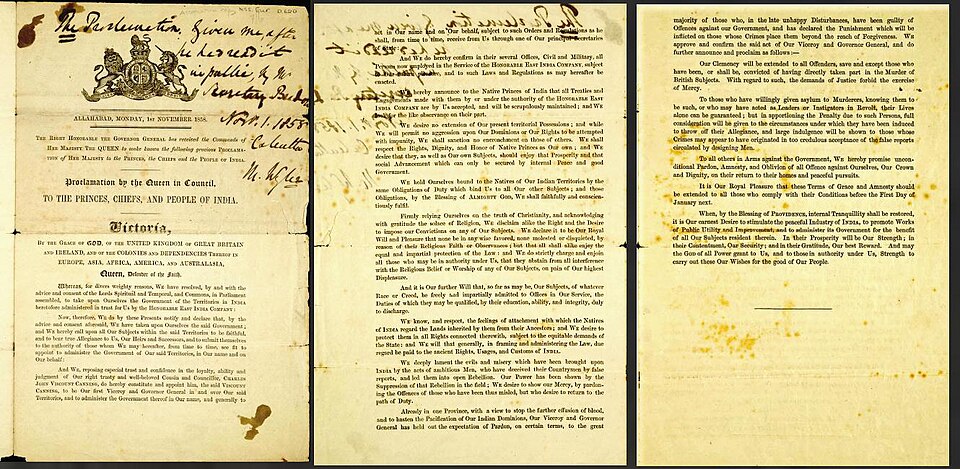
Allahabad Durbar (1 November 1858) — Queen Victoria's Proclamation
Lord Canning reading Queen Victoria's Proclamation, transferring government of India from the East India Company directly to the British Crown.
Evolution of India's Supreme Executive Post (1757–1858)
Governor of Bengal
1757 – 1773Governor-General of Bengal
1773 – 1833Governor-General of India
1833 – 1858Viceroy & Governor-General of India
👑8. Master Comparison Table: Constitutional Evolution (1773–1858)
| Act | Key Constitutional Innovation | Head of Administration | Commercial Status of EIC |
|---|---|---|---|
| Regulating Act 1773 | Supreme Court at Calcutta (1774); Executive Council of 4 | Governor-General of Bengal (Warren Hastings) | Private trade prohibited |
| Pitt's India Act 1784 | System of Double Government (Board of Control + Court of Directors) | Governor-General in Council | Commercial vs Political separated |
| Charter Act 1813 | ₹1 Lakh for Indian Education; Missionaries allowed | Governor-General of Bengal | Monopoly ended except Tea & China trade |
| Charter Act 1833 | Total Centralization; Law Member added (Macaulay) | Governor-General of India (William Bentinck) | Commercial monopoly completely ended |
| Charter Act 1853 | Separate Legislative Council; Open Civil Services exam | Governor-General of India | Admin body until Parliament decides |
| GoI Act 1858 | Crown Rule; Secretary of State + 15 member Council | Viceroy of India (Lord Canning) | Company liquidated |
Previous Year Questions (PYQs) Practice
Test your conceptual clarity with authentic exam questions
Under which of the following Acts was the "Board of Control" created, thereby establishing the system of Double Government in British India?
Pitt's India Act of 1784 established the Board of Control to supervise political, civil, and military affairs while the Court of Directors managed commercial affairs, instituting the System of Double Government.
Who among the following was the first Governor-General of India created by the Charter Act of 1833?
The Charter Act of 1833 redesignated the Governor-General of Bengal as the Governor-General of India. Lord William Bentinck was the first Governor-General of India.
By which Charter Act was the commercial monopoly of the East India Company completely abolished (including trade in tea and trade with China)?
While the Charter Act of 1813 ended general monopoly, it preserved tea and China trade. The Charter Act of 1833 completely abolished all commercial monopolies, turning EIC into a purely administrative body.
The Supreme Court at Calcutta was established under which Act, with Sir Elijah Impey as its first Chief Justice?
The Regulating Act of 1773 provided for the establishment of a Supreme Court at Calcutta, which was formally constituted in 1774 with Sir Elijah Impey as Chief Justice.
An open competitive examination for the recruitment of the Indian Civil Services was introduced for the first time by which of the following Acts?
The Charter Act of 1853 introduced open competition for civil services. Following this, the Macaulay Committee on the Indian Civil Service was appointed in 1854.