
Making of the Constitution
Genesis of the Constituent Assembly, Cabinet Mission Plan 1946, Drafting Committee, Objectives Resolution, and key adoption milestones.
1. Genesis & Demand for a Constituent Assembly
The demand for a representative assembly to draft a constitution for free India emerged during the national freedom movement:
- 1934: The idea was put forward for the very first time by M.N. Roy (a pioneer of the communist movement in India).
- 1935: The Indian National Congress (INC) officially demanded a Constituent Assembly to frame the Constitution of India for the first time.
- 1938: Jawaharlal Nehru, on behalf of the INC, declared: "The Constitution of free India must be framed, without outside interference, by a Constituent Assembly elected on the basis of adult franchise."
- 1940 (August Offer): The demand was conceded in principle for the first time by the British Government in Viceroy Linlithgow's 'August Offer'.
- 1942 (Cripps Mission): Sir Stafford Cripps came to India with a draft declaration proposing an elected Constituent Assembly after World War II. The proposals were rejected by the Muslim League, which insisted on two separate autonomous states with two separate Constituent Assemblies.
- 1946 (Cabinet Mission Plan): A three-member British Cabinet delegation (Lord Pethick-Lawrence, Sir Stafford Cripps, and A.V. Alexander) arrived in India. While rejecting the demand for two separate assemblies, it formulated a scheme for a single Constituent Assembly which was accepted by all major parties.
Key Milestones in the Making of the Constitution (1934–1950)
Idea of Assembly
M.N. Roy put forward the idea of a Constituent Assembly for India for the first time.
August Offer
British Government accepted in principle that Indians should frame their own constitution.
Cabinet Mission
Formula for Constituent Assembly accepted; elections held in July–August 1946.
First Meeting
Dr. Sachchidananda Sinha as temp President; Dr. Rajendra Prasad elected President on 11 Dec.
Objectives Resolution
Moved by Nehru; adopted 22 Jan 1947; formed philosophical bedrock of Preamble.
Drafting Committee
7-member committee set up under the chairmanship of Dr. B.R. Ambedkar.
Constitution Adopted
Passed & signed by 284 members. Celebrated as National Constitution Day.
Constitution Commenced
India became a Sovereign Democratic Republic; celebrated annually as Republic Day.
2. Composition of the Constituent Assembly
Under the scheme formulated by the Cabinet Mission Plan (May 1946):
- Total Strength: The total strength was fixed at 389 seats:
- 296 seats allotted to British India (292 from 11 Governors' Provinces + 4 from Chief Commissioners' Provinces: Delhi, Ajmer-Merwara, Coorg, and British Baluchistan).
- 93 seats allotted to the Princely States.
- Population-Based Allocation: Roughly one seat was allocated for every one million (10 Lakh) population.
- Communal Representation: Seats allocated to each British province were divided among three principal communities: Muslims, Sikhs, and General (all except Muslims and Sikhs), in proportion to their population.
- Method of Election:
- Representatives of British Indian provinces were indirectly elected by members of the Provincial Legislative Assemblies using proportional representation by means of a single transferable vote.
- Representatives of Princely States were nominated by the heads of the princely states.
Frequent Exam Statement Trap:
- The Constituent Assembly was NOT directly elected by the people of India on adult franchise (provincial assemblies themselves had been elected on a limited franchise based on tax, property, and education under the GoI Act 1935).
- It was a partly elected and partly nominated body.
- Although indirectly elected, it comprised representatives from all sections of Indian society (Hindus, Muslims, Sikhs, Parsis, Anglo-Indians, Indian Christians, SCs, STs, and women).
- Mahatma Gandhi and Muhammad Ali Jinnah were notably NOT members of the Constituent Assembly.
Composition of the Constituent Assembly: Cabinet Mission Plan (1946)
Roughly 1 seat per million (10 Lakh) population
Elected by provincial legislative assemblies using single transferable vote system.
Madras, Bombay, UP, Bihar, etc.
Delhi, Ajmer-Merwara, Coorg, British Baluchistan
Nominated by heads of princely states (rulers/kings; no direct or indirect elections).
Reconstituted Assembly: 389 Reduced to 299 Seats
Following Muslim League withdrawal: Indian provinces had 229 seats and Princely States had 70 seats.
3. Working of the Constituent Assembly
The Constituent Assembly held its historic first session in the Constitution Hall (now Central Hall of Parliament House, New Delhi):
- First Meeting (9 December 1946): Attended by 211 members (the Muslim League boycotted the meeting and insisted on a separate state of Pakistan). Following the French practice of electing the oldest member, Dr. Sachchidananda Sinha was elected as the temporary President of the Assembly.
- Permanent Officers (11 December 1946):
- President: Dr. Rajendra Prasad was unanimously elected as the permanent President.
- Vice-Presidents: The Assembly had two Vice-Presidents: H.C. Mukherjee and V.T. Krishnamachari.
- Constitutional Advisor: Sir Benegal Narsing Rau (B.N. Rau) was appointed as the Legal/Constitutional Advisor to the Assembly.
- The Objectives Resolution (13 December 1946):
- Moved by Jawaharlal Nehru, this historic resolution outlined the guiding philosophy and fundamental objectives of the constitutional structure.
- Unanimously adopted on 22 January 1947.
- Its modified version forms the Preamble to the Indian Constitution.
4. Committees of the Constituent Assembly
To handle different tasks of constitution-making, the Assembly appointed 22 committees (8 major committees and several minor ones):
Major Committees & Chairmen:
- Drafting Committee: Dr. B.R. Ambedkar
- Union Powers Committee: Jawaharlal Nehru
- Union Constitution Committee: Jawaharlal Nehru
- Provincial Constitution Committee: Sardar Vallabhbhai Patel
- Advisory Committee on Fundamental Rights, Minorities, and Tribal Areas: Sardar Vallabhbhai Patel
- Rules of Procedure Committee: Dr. Rajendra Prasad
- Steering Committee: Dr. Rajendra Prasad
- States Committee (Committee for Negotiating with States): Jawaharlal Nehru
The Drafting Committee (29 August 1947):
Among all committees, the Drafting Committee was the most critical body set up to prepare a draft of the new Constitution based on the initial draft prepared by Constitutional Advisor Sir B.N. Rau.
It consisted of 7 members headed by Dr. B.R. Ambedkar.
Drafting Committee Structure (Set up: 29 August 1947)
Dr. B.R. Ambedkar
First Law Minister of independent India. Recognized as the Chief Architect of the Constitution and Modern Manu.
Sir B.N. Rau
Prepared the initial rough draft of the Constitution for the Drafting Committee.
K.M. Munshi
Eminent lawyer and politician; only sole party-Congress member from inception.
Alladi Krishnaswami Iyer
Former Advocate-General of Madras and prominent jurist.
N. Gopalaswami Ayyangar
Former Prime Minister of Kashmir and seasoned civil servant.
Syed Mohammad Sadullah
Former Premier of Assam and representative of Muslim League.
N. Madhava Rau
Replaced B.L. Mitter who resigned due to failing health.
T.T. Krishnamachari
Replaced D.P. Khaitan following his demise in 1948.
5. Enactment & Commencement of the Constitution
The Constitution underwent three detailed readings in the Assembly:
- First Reading (4 Nov 1948 – 9 Nov 1948): General discussion.
- Second Reading (15 Nov 1948 – 17 Oct 1949): Clause-by-clause consideration; over 7,635 amendments were proposed, of which 2,473 were discussed.
- Third Reading (14 Nov 1949 – 26 Nov 1949): Final motion moved by Dr. Ambedkar.
On 26 November 1949, the motion on the draft constitution was declared passed, receiving the signatures of 284 members present out of 299.
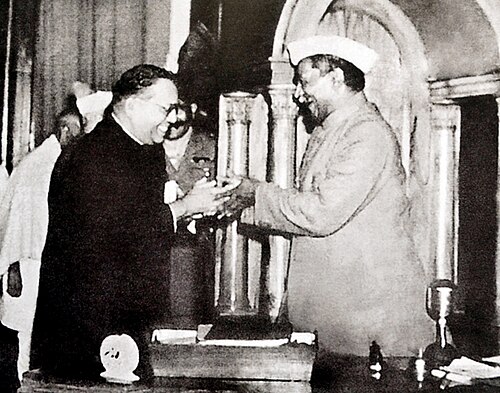
Dr. B.R. Ambedkar presenting the final draft of the Indian Constitution to Dr. Rajendra Prasad (25 November 1949)
The final draft of the Constitution was adopted by the Constituent Assembly on 26 November 1949. The original text contained a Preamble, 395 Articles, and 8 Schedules.
- Date of Adoption (अंगीकृत करने की तिथि): 26 November 1949. Certain provisions came into force immediately on this date (Citizenship, Elections, Provisional Parliament, Temporary & Transitional Provisions under Articles 5, 6, 7, 8, 9, 60, 324, 366, 367, 379, 380, 388, 391, 392, and 393).
- Date of Commencement (लागू होने की तिथि): 26 January 1950. The remaining and major provisions of the Constitution came into force on this date, celebrated as Republic Day. Historical Reason: 26 January was specifically chosen to commemorate the declaration of Purna Swaraj (Complete Independence) at the Lahore Session of the INC in December 1929, which was first celebrated on 26 January 1930.
With the commencement of the Constitution on 26 January 1950, Article 395 formally repealed:
- The Indian Independence Act, 1947
- The Government of India Act, 1935 (along with all amending enactments) Note: The Abolition of Privy Council Jurisdiction Act (1949) was, however, continued.
6. Master Summary Table: Important Facts & Assembly Trivia
| Topic / Element | Historical Detail / Fact | Exam Relevance |
|---|---|---|
| Elephant Symbol | Adopted as the official seal/symbol of the Constituent Assembly | Frequently tested symbol |
| Constitutional Advisor | Sir B.N. Rau (prepared initial draft of Constitution) | Never a member of the Assembly |
| Secretary to Assembly | H.V.R. Iyengar | Administrative head |
| Chief Draftsman | S.N. Mukerjee | Drafted the complex legislative language |
| Calligrapher (English) | Prem Behari Narain Raizada (flowing italic style) | Charged no fee, signed every page |
| Calligrapher (Hindi) | Vasant Krishan Vaidya | Calligraphed the Hindi version |
| Illuminations & Art | Beohar Rammanohar Sinha & Nandalal Bose (Santiniketan) | Decorated borders and preamble |
| National Flag | Adopted on 22 July 1947 (designed by Pingali Venkayya) | Pre-independence adoption |
| National Anthem & Song | "Jana Gana Mana" & "Vande Mataram" adopted on 24 January 1950 | Final meeting decisions |
| First President of India | Dr. Rajendra Prasad elected on 24 January 1950 | Unanimously chosen by Assembly |
Previous Year Questions (PYQs) Practice
Test your conceptual clarity with authentic exam questions
Who among the following moved the historic "Objectives Resolution" in the Constituent Assembly on 13th December 1946?
Jawaharlal Nehru moved the historic Objectives Resolution on December 13, 1946, which laid down the philosophy of the Constitution and later became the Preamble.
Who was appointed as the Constitutional Advisor to the Constituent Assembly?
Sir Benegal Narsing Rau (B.N. Rau) was appointed as the legal/constitutional advisor to the Constituent Assembly.
Who replaced B.L. Mitter on the Drafting Committee of the Constituent Assembly after he resigned due to ill health?
N. Madhava Rau replaced B.L. Mitter who resigned due to failing health, while T.T. Krishnamachari replaced D.P. Khaitan upon his death in 1948.
What was the total number of seats in the Constituent Assembly allocated by the Cabinet Mission Plan (1946)?
The Cabinet Mission Plan allotted a total of 389 seats (296 for British India and 93 for Princely States). After partition, this was reduced to 299.
Which animal was adopted as the official emblem/seal of the Constituent Assembly of India?
The Elephant was adopted as the official emblem and seal of the Constituent Assembly.