
State Legislature: Vidhan Sabha and Vidhan Parishad
Exhaustive constitutional guide on the State Legislature (Articles 168 to 212): 6 Bicameral States, Article 169 creation/abolition procedure, numerical limits, Article 171 five-way electoral quota, ordinary bill procedure (max 4-month delay), Money Bills, and absolute absence of Joint Sitting.
1. Constitutional Architecture and Bicameralism (Articles 168 to 177)
Articles 168 to 212 in Part VI of the Constitution detail the organization, composition, duration, officers, procedures, privileges, and powers of the State Legislature.
1. Unicameral vs Bicameral Systems
Unlike the Parliament of India which is mandatorily bicameral, the Constitution does not mandate a uniform bicameral system for all states:
- Most Indian states have a unicameral legislature, consisting of the Governor and the Legislative Assembly (Vidhan Sabha).
- Currently, only 6 states possess a bicameral legislature, consisting of the Governor, the Legislative Assembly (Vidhan Sabha - Lower House), and the Legislative Council (Vidhan Parishad - Upper House):
- Uttar Pradesh (100 seats)
- Maharashtra (78 seats)
- Bihar (75 seats)
- Karnataka (75 seats)
- Andhra Pradesh (58 seats)
- Telangana (40 seats)
[!NOTE] Historical Evolution of Bicameral States Jammu and Kashmir had a Legislative Council until its reorganization into Union Territories in 2019. Tamil Nadu abolished its Legislative Council in 1986, Punjab and West Bengal in 1969, and Andhra Pradesh abolished its Council in 1985 before reviving it in 2007.
Vidhan Sabha vs Vidhan Parishad: Composition, Election & Powers Matrix
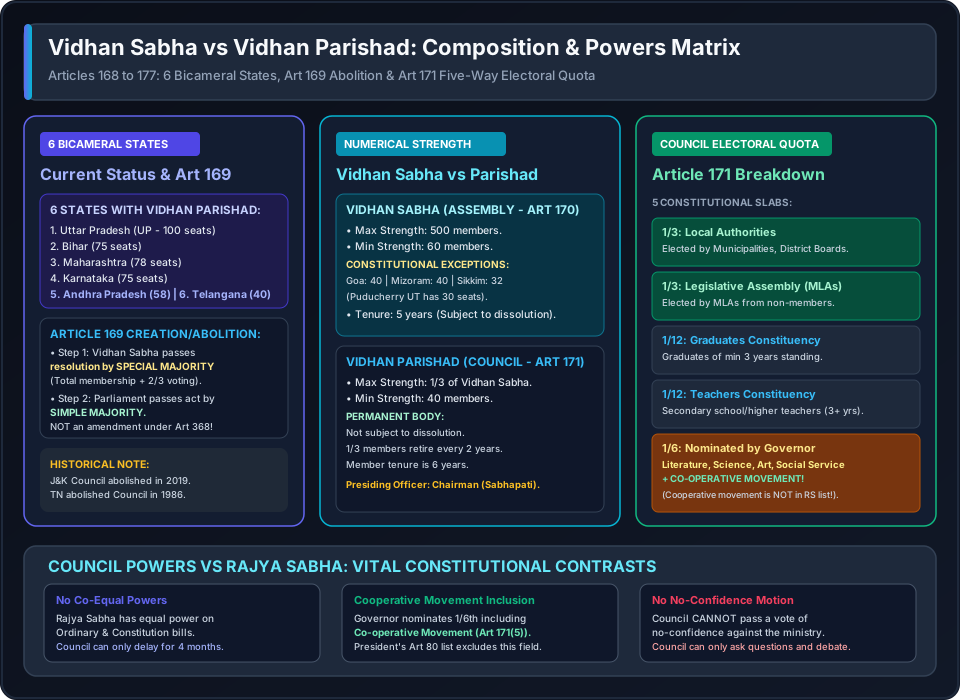
2. Creation and Abolition of Legislative Councils (Article 169)
The Constitution provides an asymmetric two-step constitutional mechanism for creating or abolishing a Legislative Council:
- Resolution by the State Legislative Assembly: The Assembly must pass a resolution to that effect by a Special Majority:
- A majority of the total membership of the Assembly, AND
- A majority of not less than two-thirds of the members present and voting.
- Act of Parliament: Parliament may then pass an Act to create or abolish the Council by a Simple Majority.
- Exclusion from Article 368: Article 169(3) explicitly declares that such a law shall NOT be deemed to be an amendment of the Constitution under Article 368.
2. Composition and Numerical Rules (Articles 170 and 171)
1. Legislative Assembly (Vidhan Sabha - Article 170)
- Direct Election: Directly elected by the people of the state on the basis of adult suffrage from territorial constituencies.
- Maximum Strength: 500 members.
- Minimum Strength: 60 members.
- Constitutional Exceptions:
- Goa: 40 members
- Mizoram: 40 members
- Sikkim: 32 members
- (Puducherry Union Territory has 30 elected members).
2. Legislative Council (Vidhan Parishad - Article 171)
- Indirect Election & Permanent Nature: The Council is a permanent body and is not subject to dissolution. One-third of its members retire every two years, giving members a 6-year tenure.
- Maximum Strength: Shall not exceed one-third (1/3) of the total membership of the Legislative Assembly of that state.
- Minimum Strength: Shall not be less than 40 members (Telangana has the minimum of 40 seats).
Sign up for Free to Continue Reading
Create a free RojgarSetu account to unlock the full chapter, interactive PYQ practice sets, mindmaps, and track your completion progress.