
Prime Minister & Council of Ministers
Comprehensive constitutional guide on the Prime Minister and Central Council of Ministers (Articles 74, 75, 78), 91st Amendment size ceiling, Collective vs Individual Responsibility, Cabinet vs Council of Ministers, and appointment conventions.
1. Constitutional Status and Framework (Articles 74, 75, 78)
In the Indian parliamentary system modeled on the British Westminster pattern, the President is the nominal executive authority (de jure executive), whereas the Prime Minister is the real executive authority (de facto executive). The Prime Minister serves as the Head of the Government, while the President serves as the Head of the State.
The constitutional architecture governing the Prime Minister and the Union Council of Ministers revolves around three foundational Articles in Part V:
1. Article 74: Council of Ministers to Aid and Advise the President
- Article 74(1): Mandates that there shall be a Council of Ministers with the Prime Minister at the head to aid and advise the President, who shall, in the exercise of their functions, act in accordance with such advice.
- The Binding Nature of Advice:
- 42nd Constitutional Amendment Act, 1976: Made the advice of the Council of Ministers strictly binding upon the President.
- 44th Constitutional Amendment Act, 1978: Added a crucial proviso allowing the President to require the Council of Ministers to reconsider such advice, either generally or otherwise. However, the President must act in accordance with the advice tendered after such reconsideration.
2. Article 75: Appointment, Tenure, Responsibility, and Salaries
- Article 75(1) (Appointment): The Prime Minister is appointed by the President, and other ministers are appointed by the President on the advice of the Prime Minister.
- Article 75(2) (Tenure / Pleasure Doctrine): Ministers hold office during the pleasure of the President. This represents the doctrine of Individual Responsibility.
- Article 75(3) (Collective Responsibility): The Council of Ministers is collectively responsible to the Lok Sabha (House of the People), not to Parliament as a whole.
- Article 75(4) (Oath): Administered by the President according to the forms set out in the Third Schedule (Oath of Office and Oath of Secrecy).
- Article 75(5) (Six-Month Rule): A minister who is not a member of either House of Parliament for any period of six consecutive months ceases to be a minister at the expiration of that period.
- Article 75(6) (Salaries): Determined by Parliament by law from time to time.
3. Article 78: Duties of the Prime Minister
Article 78 defines the constitutional channel of communication between the President and the Council of Ministers:
- To communicate to the President all decisions of the Council of Ministers relating to the administration of the affairs of the Union and proposals for legislation.
- To furnish such information relating to the administration and legislative proposals as the President may call for.
- If the President so requires, to submit for the consideration of the Council of Ministers any matter on which a decision has been taken by an individual minister but which has not been considered by the Council.
🔗 EXECUTIVE RELATIONS CHAINArticles 74, 75 & 78: Constitutional Nexus of President, PM and Council of Ministers
Binding Advice (42nd & 44th Amendments) and PM's Duty to Inform under Article 78👉 Swipe horizontally to view full diagram ↔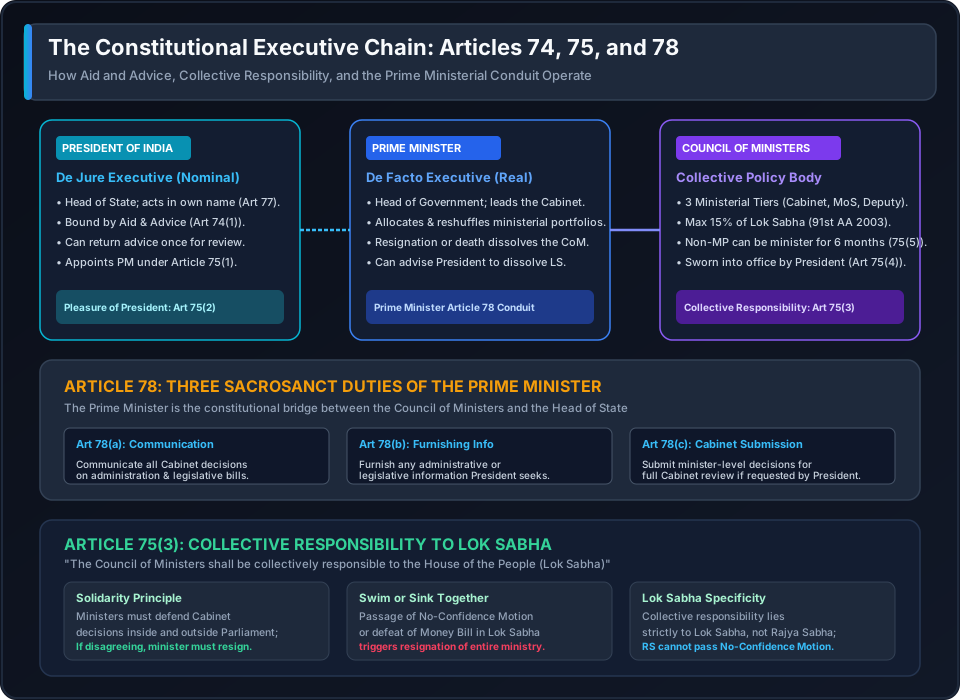 ⚖️ Article 74(2): The nature of advice tendered by ministers to the President cannot be inquired into in any court.🏛️ EXECUTIVE ORGANOGRAM
Hierarchy and Institutional Architecture of the Union Executive
🔒Sign up for Free to Continue Reading
Create a free RojgarSetu account to unlock the full chapter, interactive PYQ practice sets, mindmaps, and track your completion progress.
✓ Full Chapter Content✓ 5+ Interactive PYQs✓ Progress Tracking✓ 100% Free Forever🔍