
High Courts and Subordinate Courts
Comprehensive constitutional guide on High Courts and Subordinate Judiciary (Articles 214 to 237): 25 High Courts, appointment criteria, Article 226 vs 32 writ comparison, Article 227 superintendence, Article 233 appointment of District Judges, civil vs criminal trial hierarchy, and Lok Adalats.
1. Constitutional Evolution and Composition of High Courts (Articles 214 to 224)
Under the single integrated judicial system of India, the High Court operates as the apex judicial authority at the state level, positioned directly beneath the Supreme Court of India.
1. Historical Evolution
- The institution of High Courts originated in India under the Indian High Courts Act, 1861, which established three High Courts in 1862 at Calcutta, Bombay, and Madras.
- In 1866, a fourth High Court was established at Allahabad (originally at Agra).
- Current Number of High Courts: There are currently 25 High Courts in India. The 25th High Court is the High Court of Andhra Pradesh at Amaravati, established on January 1, 2019 following the bifurcation of the state.
2. Territorial Jurisdiction and Common High Courts (Article 231)
- Article 214: Mandates that there shall be a High Court for each state.
- Article 231: Empowers Parliament by law to establish a common High Court for two or more states, or for two or more states and a Union Territory:
- Bombay High Court: Exercises jurisdiction over Maharashtra, Goa, Dadra and Nagar Haveli, and Daman and Diu.
- Punjab and Haryana High Court: Exercises jurisdiction over Punjab, Haryana, and Chandigarh.
- Gauhati High Court: Exercises jurisdiction over Assam, Nagaland, Mizoram, and Arunachal Pradesh.
- Calcutta High Court: Exercises jurisdiction over West Bengal and Andaman and Nicobar Islands.
- Kerala High Court: Exercises jurisdiction over Kerala and Lakshadweep.
- Madras High Court: Exercises jurisdiction over Tamil Nadu and Puducherry.
3. Appointment of Judges and the Collegium System (Article 217)
- Appointed by the President: Every High Court judge (including the Chief Justice) is appointed by the President of India (NOT by the Governor!).
- Consultation Process:
- For the Chief Justice of a High Court: The President consults the Chief Justice of India (CJI) and the Governor of the concerned state.
- For Other Judges of a High Court: The President consults the CJI, the Governor of the state, and the Chief Justice of the concerned High Court.
4. Qualifications for Appointment (Article 217(2))
A candidate must be a citizen of India and must have satisfied at least one of the following:
- Held a judicial office in the territory of India for at least 10 years; OR
- Been an advocate of a High Court (or of two or more such courts in succession) for at least 10 years.
[!WARNING] Crucial Constitutional Difference from the Supreme Court Unlike the Supreme Court (Article 124(3)(c)), the Constitution makes NO provision for appointing a "distinguished jurist" as a judge of a High Court! A distinguished jurist can be appointed only to the Supreme Court, not to any High Court.
5. Tenure, Retirement Age and Removal
- Retirement Age: A High Court judge holds office until reaching the age of 62 years (raised from 60 years by the 15th Constitutional Amendment Act, 1963). In comparison, Supreme Court judges retire at 65 years.
- Resignation: May resign by submitting a handwritten resignation to the President of India.
- Removal Procedure: A High Court judge can be removed from office by the President on the grounds of proved misbehaviour or incapacity, using the exact same procedure as that for a Supreme Court judge under the Judges (Inquiry) Act, 1968 (an address supported by a special majority in both Houses of Parliament in the same session).
2. Jurisdiction and Powers of High Courts (Articles 215, 226 and 227)
⚖️ HIGH COURT JURISDICTIONHigh Court Jurisdiction: Article 226 vs 32, Superintendence & Court of Record
Articles 214 to 228: Wider Writ Scope, Art 227 Superintendence & Judicial Appointment Criteria👉 पूरा चार्ट देखने हेतु स्क्रॉल करें ↔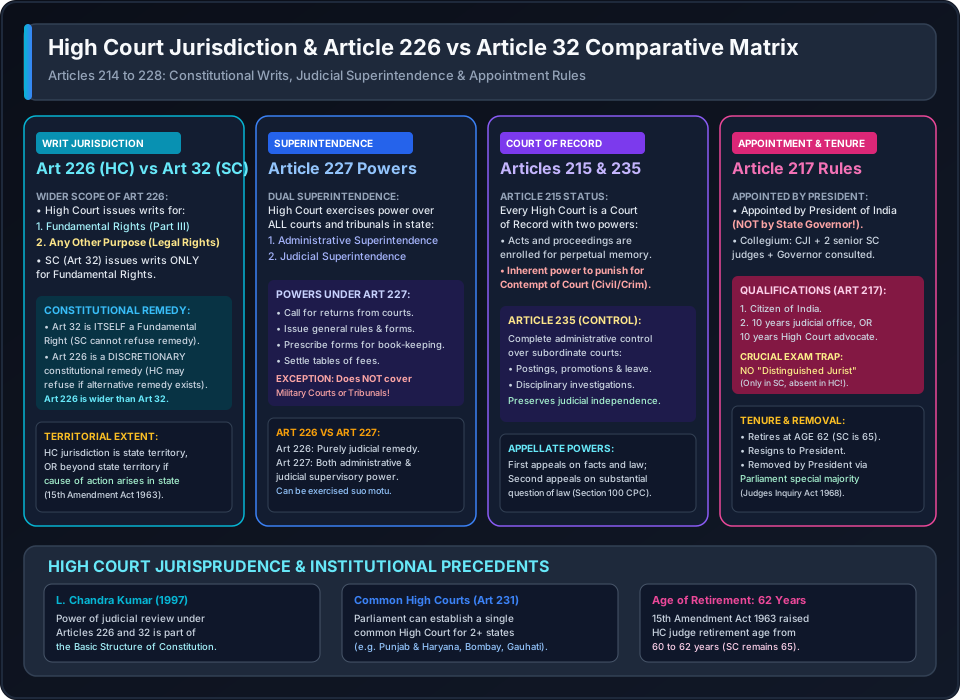 🔒
Sign up for Free to Continue Reading
Create a free RojgarSetu account to unlock the full chapter, interactive PYQ practice sets, mindmaps, and track your completion progress.
✓ Full Chapter Content✓ 5+ Interactive PYQs✓ Progress Tracking✓ 100% Free Forever🔍