
Governor, Chief Minister and State Council of Ministers
Comprehensive constitutional guide on the State Executive (Articles 153 to 167): Governor's dual role, doctrine of pleasure, discretionary powers (Art 163), legislative veto (Art 200/201), ordinance making (Art 213), pardoning powers (Art 161 vs 72), and Council of Ministers (91st Amendment).
1. Constitutional Position and Dual Role of the Governor (Articles 153 to 160)
Part VI of the Constitution of India deals with the State Government. The State Executive consists of the Governor, the Chief Minister, the State Council of Ministers, and the Advocate General for the State (Article 165). Unlike the Union Executive, there is no office of Vice-Governor in the states.
1. Dual Capacity of the Governor
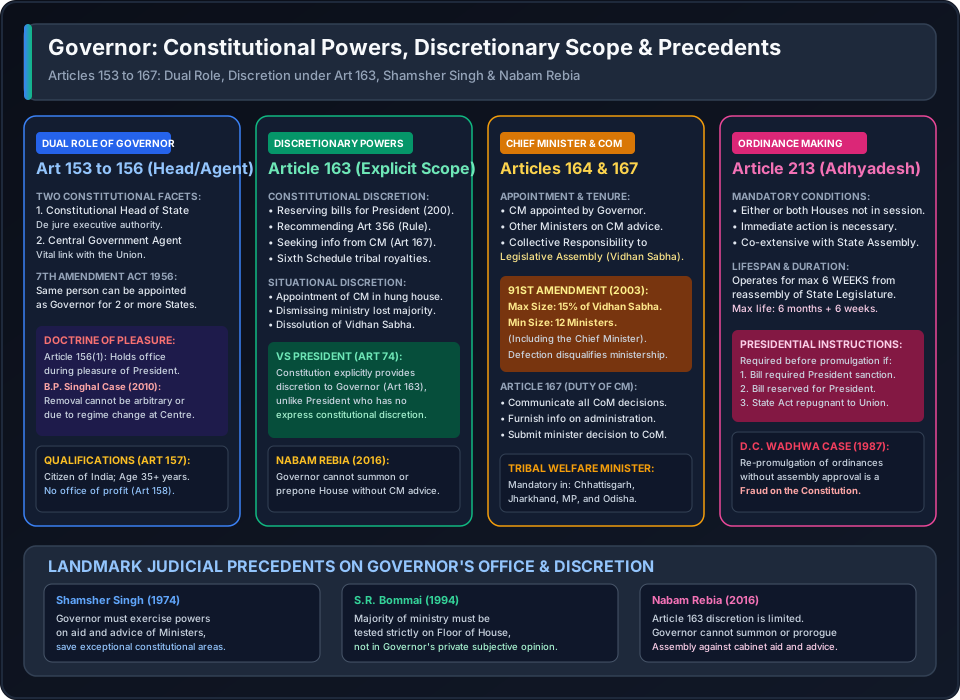
Under the Indian federal model, the Governor occupies a unique dual constitutional position:
- Constitutional (Nominal) Head of the State: Acting as the de jure executive head, all executive actions of the state government are formally taken in the Governor's name (Article 166). The Governor is guided by the aid and advice of the Council of Ministers headed by the Chief Minister.
- Representative / Agent of the Central Government: Serving as a crucial bridge between the Union and the State, ensuring that state administration conforms to the constitutional directives of the Union (Articles 256, 257, and 356).
[!NOTE] 7th Constitutional Amendment Act, 1956 Originally, Article 153 provided for a separate Governor for each state. The 7th Constitutional Amendment Act, 1956 added a proviso permitting the appointment of the same person as Governor for two or more states. When the same person is appointed as Governor of multiple states, their emoluments and allowances are allocated among the respective states in proportions determined by the President (Article 158(3A)).
Governor: Powers, Discretionary Scope & Landmark Precedents
2. Appointment and Qualifications (Articles 155 to 158)
- Appointed by the President: The Governor is not elected either directly by the people or indirectly through an electoral college. Instead, the Governor is appointed directly by the President under his hand and seal (Article 155). This Canadian model was chosen by the Constituent Assembly to preserve national unity and prevent friction between the Governor and the Chief Minister.
- Constitutional Qualifications (Article 157):
- Must be a citizen of India.
- Must have completed the age of 35 years.
- Conditions of Office (Article 158): Must not be a member of either House of Parliament or State Legislature; must not hold any office of profit; emoluments cannot be diminished during their term of office.
- Conventions:
- An outsider should be appointed (a person should not belong to the state where they are appointed).
- The Chief Minister of the state concerned should be consulted by the Union prior to appointment (often disregarded in practice).
3. Term of Office and Doctrine of Pleasure (Article 156)
A Governor holds office for a term of 5 years from the date of entering office, subject to the Doctrine of Pleasure (Article 156(1)):
- The Governor holds office during the pleasure of the President.
- The Constitution mentions no grounds or procedure for removal of the Governor (unlike the President who is impeached under Article 61).
- B.P. Singhal v. Union of India (2010): A 5-judge Constitution Bench held that while the President can remove a Governor without assigning reasons, this power is not absolute. Removal cannot be arbitrary, capricious, or unreasonable, nor can it be done simply because the political party in power at the Centre changes. Such removal is subject to judicial review.
2. Discretionary Powers of the Governor (Article 163)
Article 163(1) mandates that there shall be a Council of Ministers with the Chief Minister at the head to aid and advise the Governor, except in so far as he is by or under this Constitution required to act in his discretion.
1. Crucial Contrast Between Article 74 and Article 163
This is one of the most tested areas in competitive examinations:
- President (Article 74): After the 42nd and 44th Amendments, the President is mandatorily bound by cabinet advice. The Constitution gives the President NO express constitutional discretion.
- Governor (Article 163): The Constitution explicitly recognizes that the Governor can act in their discretion. Article 163(2) states that if any question arises whether any matter falls within the Governor's discretion, the decision of the Governor in their discretion shall be final, and the validity of anything done by the Governor cannot be questioned on the ground that they ought or ought not to have acted in discretion.
Sign up for Free to Continue Reading
Create a free RojgarSetu account to unlock the full chapter, interactive PYQ practice sets, mindmaps, and track your completion progress.