
Parliament of India
Master guide on the Parliament of India (Articles 79 to 122): Lok Sabha and Rajya Sabha composition, Speaker's role, Ordinary vs Money Bills, Joint Sitting (Article 108), 6-stage Budget cycle, parliamentary devices, and Financial Committees (PAC, Estimates, CoPU).
1. Organization and Composition of Parliament (Articles 79 to 83)
The Parliament of India is the supreme legislative body of the Union. Codified under Part V (The Union) from Articles 79 to 122, it embodies the bicameral legislature of the Republic.
1. Composition of Parliament (Article 79)
Article 79 explicitly defines the three constituent organs of Parliament:
- The President of India
- The Council of States (Rajya Sabha)
- The House of the People (Lok Sabha)
[!NOTE] Why is the President Part of Parliament? Though the President is not a member of either House, they are an integral part of Parliament because no bill passed by both Houses can become law without the assent of the President under Article 111. Furthermore, the President summons and prorogues both Houses and addresses joint sessions.
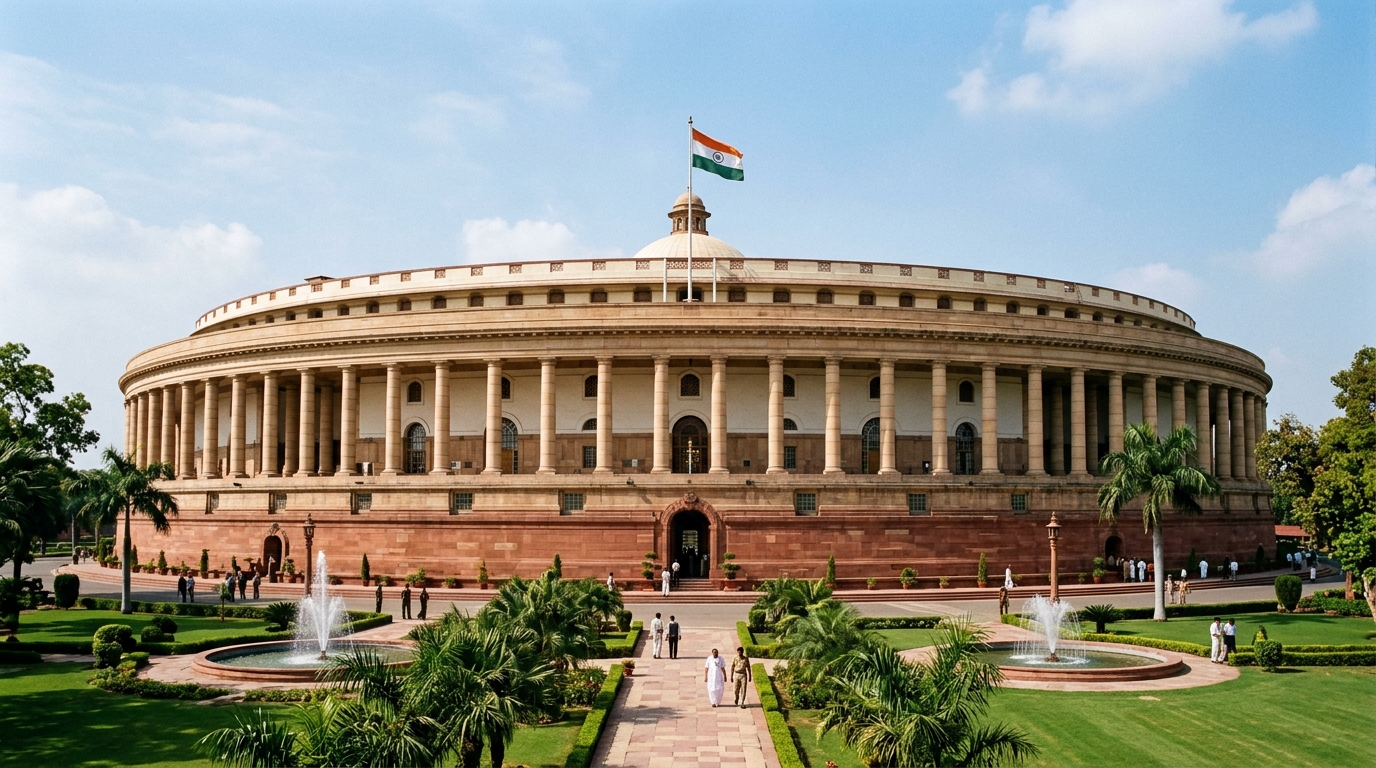
Parliament House (Samvidhan Sadan): The Apex Legislative Forum
Designed by Edwin Lutyens and Herbert Baker, this iconic circular colonnaded edifice witnessed the framing of the Indian Constitution and decades of historic parliamentary debates.
2. The Rajya Sabha (Council of States, Article 80)
- Maximum Strength: Fixed at 250 members:
- 238 representatives of the States and Union Territories (elected indirectly).
- 12 members nominated by the President having special knowledge or practical experience in Literature, Science, Art, and Social Service.
3. The Lok Sabha (House of the People, Article 81)
- Maximum Strength: Originally 552, now capped at 550 members following the 104th Constitutional Amendment Act, 2019, which discontinued the nomination of 2 Anglo-Indian members:
- Up to 530 members directly elected from territorial constituencies in the States.
- Up to 20 members representing Union Territories.
2. Presiding Officers of Parliament (Articles 89 to 98)
1. The Speaker of the Lok Sabha (Articles 93 to 96)
- Election: Elected by the Lok Sabha from amongst its members. The election date is fixed by the President.
- Tenure and Removal (Article 94):
- Resigns by submitting a letter to the Deputy Speaker.
- Can be removed by a resolution passed by an Effective Majority (a majority of all the then members of the Lok Sabha), after giving at least 14 days' advance notice.
- When a removal resolution is under consideration, the Speaker cannot preside, but has the right to speak, take part in proceedings, and vote in the first instance, though not in the case of an equality of votes (Article 96).
- Casting Vote (Article 100): Does not vote in the first instance; exercises a casting vote only in the event of an equality of votes (tie).
- Money Bill Certification (Article 110(3)): Decides whether a bill is a Money Bill or not, and their decision is final.
- Joint Sitting (Article 118(4)): Presides over a joint sitting of both Houses of Parliament.
- Anti-Defection Disqualification: Sole authority to decide disqualification under the Tenth Schedule (subject to judicial review per Kihoto Hollohan, 1992).
2. The Chairman and Deputy Chairman of Rajya Sabha (Articles 89 to 92)
- Ex-Officio Chairman: The Vice-President of India is the ex-officio Chairman of the Rajya Sabha.
- Removal: As Chairman, they are removed from office only when removed as the Vice-President (effective majority in Rajya Sabha agreed to by simple majority in Lok Sabha).
- Deputy Chairman: Elected by the Rajya Sabha from amongst its members. When the Chairman presides, the Deputy Chairman sits as an ordinary member.
3. Legislative Procedure: Ordinary Bills vs Money Bills
📜 PARLIAMENTARY BILLS & JOINT SITTINGOrdinary Bill vs Money Bill & Joint Sitting Process (Article 108)
🔒Sign up for Free to Continue Reading
Create a free RojgarSetu account to unlock the full chapter, interactive PYQ practice sets, mindmaps, and track your completion progress.
✓ Full Chapter Content✓ 5+ Interactive PYQs✓ Progress Tracking✓ 100% Free Forever🔍