
Supreme Court of India
Comprehensive constitutional guide on the Supreme Court of India (Articles 124 to 147): Collegium System evolution (Four Judges Cases), appointment & removal procedure (Judges Inquiry Act 1968), and six-fold jurisdictions (Original, Writ, Appellate, Advisory, Review, Court of Record).
1. Constitutional Organization and Independence (Articles 124 to 147)
Unlike the United States, which operates a dual system of courts (federal and state), India possesses an integrated judicial system with the Supreme Court at the apex, followed by High Courts at the state level and subordinate courts beneath them. This single hierarchy of courts enforces both central and state laws, a feature adopted from the Government of India Act, 1935.
The Supreme Court of India was inaugurated on January 28, 1950. It succeeded both the Federal Court of India (established under the 1935 Act) and the Judicial Committee of the Privy Council in London, which had previously served as the highest court of appeal.
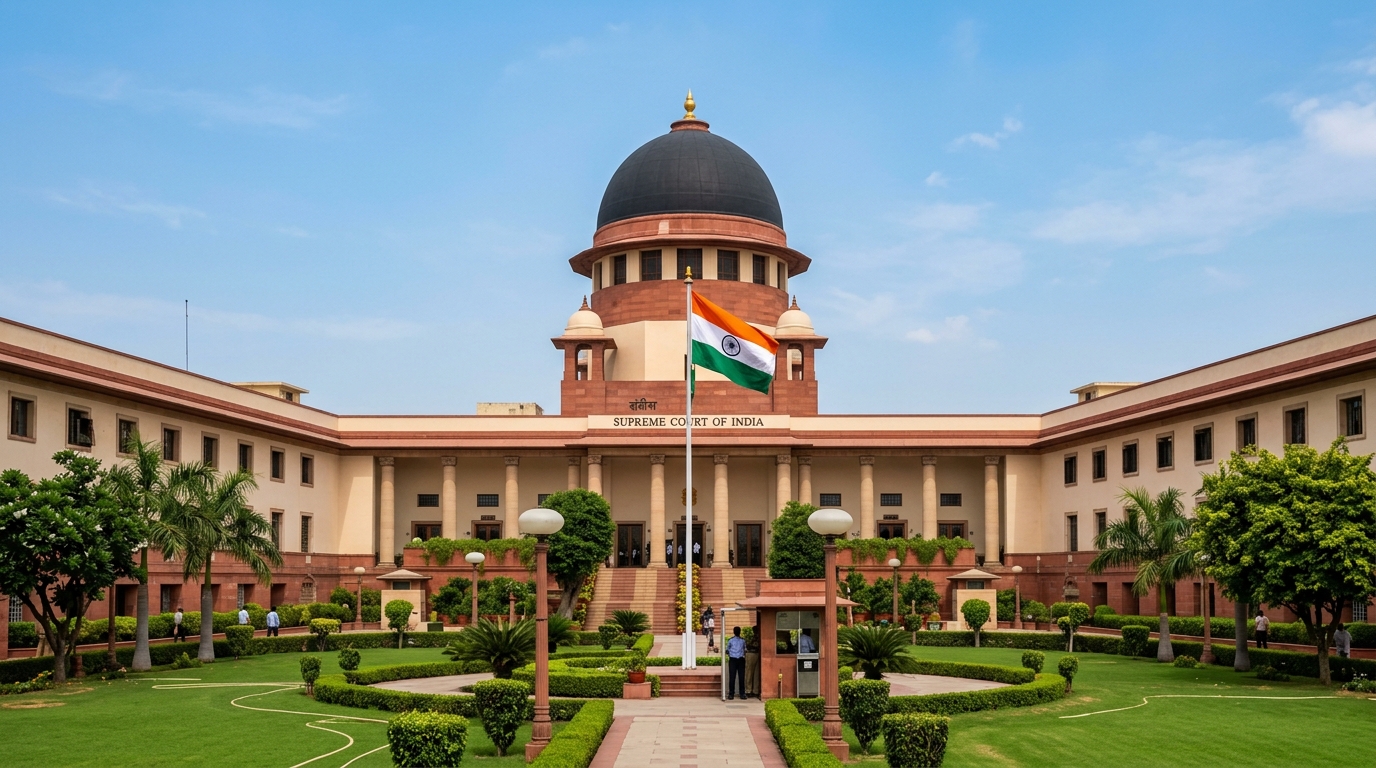
Supreme Court of India (Inaugurated 28 January 1950)
Located at Tilak Marg, New Delhi, the Supreme Court building was designed in the shape of a balance scale with wings representing the scales of justice.
1. Composition and Strength
- Original Strength (1950): 8 judges (1 Chief Justice of India + 7 other judges).
- Current Strength (2019): 34 judges (1 Chief Justice of India + 33 other judges).
- Power to Increase Strength: Under Article 124(1), Parliament has the exclusive power to regulate the number of judges by ordinary law (Supreme Court (Number of Judges) Amendment Act, 2019).
2. Qualifications for Appointment as a Judge (Article 124(3))
A candidate must be a citizen of India and must satisfy at least one of the following criteria:
- Has been for at least 5 years a Judge of a High Court (or of two or more such courts in succession); OR
- Has been for at least 10 years an Advocate of a High Court (or of two or more such courts in succession); OR
- Is, in the opinion of the President, a distinguished jurist.
[!NOTE] Distinctive Constitutional Feature The category of "distinguished jurist" exists only for appointment to the Supreme Court. It is NOT available for appointment as a High Court judge under Article 217. Furthermore, the Constitution sets NO minimum age for appointment as a judge of the Supreme Court or High Court.
3. Tenure, Resignation, and Post-Retirement Ban
- Retirement Age: Holds office until reaching the age of 65 years (compared to 62 years for High Court judges). Any question regarding the age of a Supreme Court judge is determined by such authority and in such manner as Parliament provides by law.
- Resignation: May resign by submitting a handwritten resignation to the President of India.
- Post-Retirement Restriction (Article 124(7)): No person who has held office as a judge of the Supreme Court shall plead or act in any court or before any authority within the territory of India.
2. The Collegium System: Evolution Through Four Judges Cases
The appointment of Supreme Court judges has witnessed an extensive constitutional contest between executive primacy and judicial independence regarding the interpretation of the word "consultation" in Article 124(2).
Evolution of Collegium System (Four Judges Cases) & Judges Removal Procedure
Sign up for Free to Continue Reading
Create a free RojgarSetu account to unlock the full chapter, interactive PYQ practice sets, mindmaps, and track your completion progress.